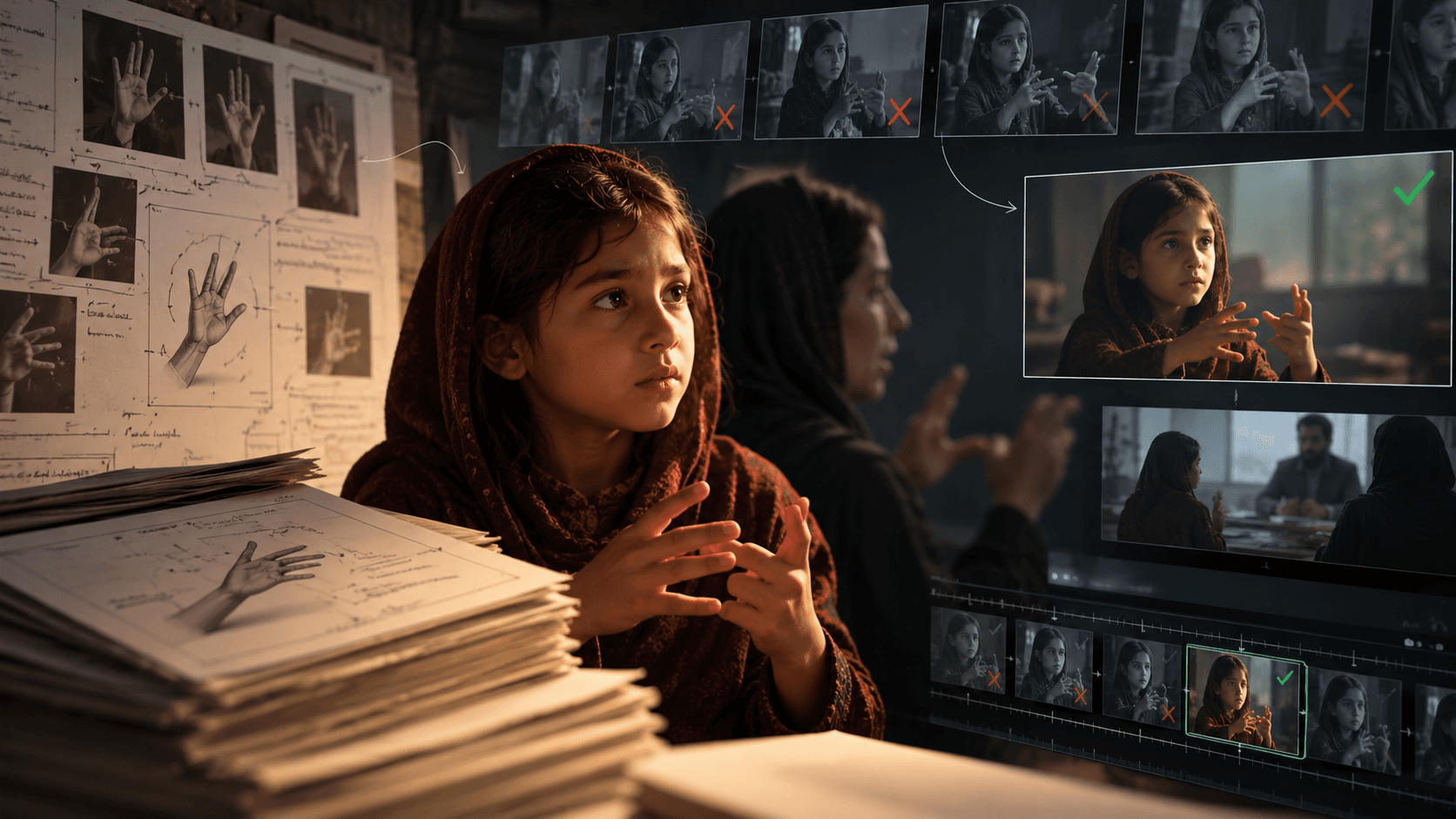
When we released MOTHER TONGUE, we published the entire production history with it. Every prompt. Every generation. Every discard.
Not a case study written afterwards, with the failures tidied away and the process made to look inevitable. The actual record, including the generations that were wrong, the ones that were nearly right, and the long middle stretch where nothing worked.
I want to describe what that cost, because the cost is the interesting part, and then make an argument about why it should be standard rather than exceptional.
The film
MOTHER TONGUE is a nine-year-old Hazara girl interpreting for her Deaf mother at a resettlement interview. Halfway through the hour she understands what she is translating — and understands that she was there when it happened.
The reason the production had to be documented is in the premise.
Deaf people who grow up without a signing community build a language at home anyway, one sign at a time, out of pictures of the things they need to say. Linguists call it home-sign. It is fluent between two people and unreadable to everyone else.
So we had to build one. Forty-six signs, invented for the film, every one specified on paper before a single frame existed: handshape, location, movement, palm orientation, non-manual markers, hold duration to the tenth of a second.
Then we generated against that specification, and discarded, and generated again, until the hand on screen matched the hand on the page.
A wrong hand in that film is not a blemish. It is a wrong word in the middle of someone's worst night.
That is why the document came first and the image came second. Not as a workflow preference. Because there was no other honest way to make it.
What publishing the record cost
It exposed the ratio. Anyone looking at the project page can count how many generations it took to get one usable shot. That number is not flattering, and it is not supposed to be. It is the truth about how this work is made, and most studios would prefer you imagine something closer to magic.
It removed the mystique, which has commercial value. Part of what a studio sells is the impression of effortless command. The record shows a team grinding against a specification, failing repeatedly, and fixing it. That is less impressive on first glance. It is far more convincing on the second.
It took real time. Capturing every prompt and every discard in a form a stranger can follow is not free. On a short film it was manageable. On a multi-deliverable brand campaign it would need to be built into the pipeline rather than assembled at the end, which is a different kind of work.
It made our failures permanent and public. There is a version of a shot in that record where the signing is subtly wrong. It is there forever. Anyone can find it.
What it bought
The claim stopped being an adjective. Every studio in this category says its work is director-led. I have written about how that sentence has become so common it means nothing. For this one film, we do not have to say it. You can read the direction. It is on the page, dated, before the frame existed.
It survived the sensitivity question. When you make a film about a Deaf family and a refugee interview using generative tools, the reasonable first reaction is suspicion. Did you take shortcuts with something you had no right to take shortcuts with? The record answers that before anyone has to ask.
It is the only thing we have made that a competitor cannot copy over a weekend. A rival can rewrite their homepage to say anything about craft and discipline. They cannot retroactively produce a record of forty-six signs specified before generation, because either they did it or they did not.
It changed who contacted us. The enquiries that came off that film were different in kind — more questions about process, more from people with difficult or sensitive subject matter, fewer about rate cards.
The argument
Here is the part I got wrong.
I thought publishing the record was a courtesy owed to the subject matter. A sensitive story, an audience entitled to know how much of it was constructed, so we showed our work.
I now think it was the most commercially significant thing we did this year, and we treated it as a one-off.
The reason is in the market. Six competing studios converged this month on the same claim about human direction, and a leading Saudi director called for legislation that would make provenance a legal matter rather than a marketing one. Everyone in this category has a sentence about rigour. Almost nobody has a file.
We have a file. We produced exactly one, by accident of subject matter, and then went back to publishing sentences like everyone else.
What we are changing
Three things, concretely.
The record becomes a standard deliverable, not a special case. Our pipeline already generates most of it — the world bible, the shot specifications, the review scores on every generated frame, the character and wardrobe locks that keep a face consistent across a campaign. Those artefacts exist today. They go in an internal folder and die there. They should go to the client.
It gets tiered, because not every project needs the full version. A social cutdown does not need forty-six documented signs. A government film, a campaign featuring a real spokesperson, anything involving likeness or cultural representation — those do. The capability should exist for all of it; the depth should scale with the stakes.
Clients can ask for it before they commission, not after. The worst time to discover your studio kept no record is when someone asks you for it.
The honest caveat
This is overhead. It will make some projects slower and some margins thinner, and anyone telling you otherwise is selling something.
There is also a real risk of it becoming theatre — a folder of artefacts nobody reads, produced to satisfy a checkbox, which is how most compliance processes die. If the record is not genuinely useful to the client, it will rot, and we will have added cost for nothing.
I would still rather build it now, while it distinguishes us, than retrofit it in eighteen months when it is a procurement requirement and the whole category is doing it badly at the same time.
The sentence is free. That is exactly why it is worthless. The file is not free, and that is exactly why it is worth something.
Credits
MOTHER TONGUE was Komodo X's entry to the Higgsfield Global Film Festival. Director: Usama Hassan. Chief AI Technologist: Syed Ali Kazim. Art Director: Z. Ali. AI Lead Artist: Faheem Ali. The full film and the complete production history, including every discard, remain public on the project page.