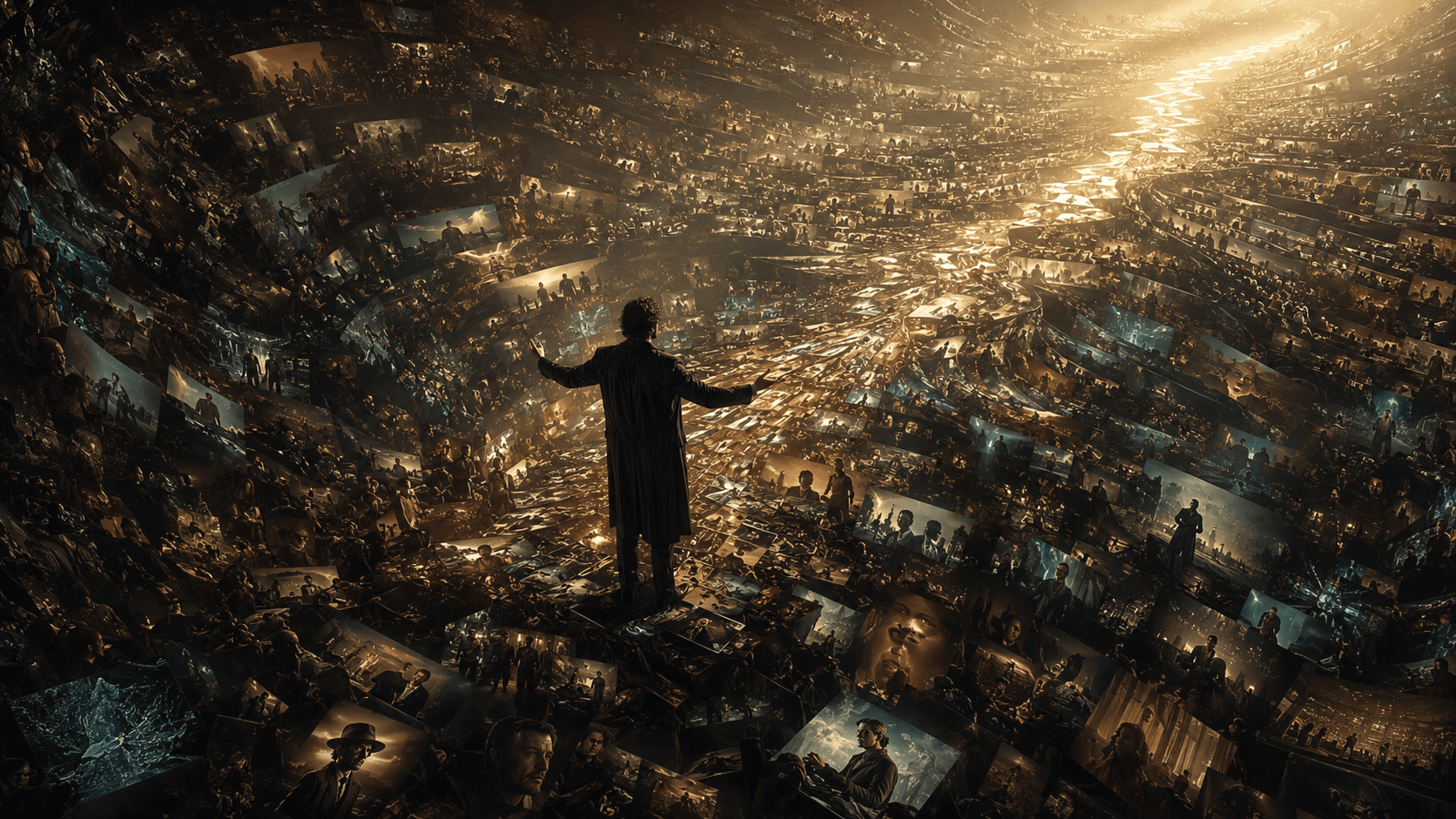
The internet keeps asking when you’ll type a sentence and get a feature film. In 2026 that is the wrong question — and the better one reveals exactly where the value in AI filmmaking is moving.
The Question Everyone Is Asking
A thread on r/aifilmmaking asked it plainly: how close are we to funding an AI system and generating a full-length, Hollywood-quality movie — 90 minutes to four hours — entirely from a prompt? And how close is the average person to generating any film they can imagine? The post drew dozens of replies from working filmmakers. The high comment-to-upvote ratio is the tell: this is a live argument, not a settled one.
It is a good question asked the wrong way. “One prompt, one feature” is a seductive headline, but it measures the wrong thing. The honest 2026 answer is that we are closer than skeptics admit and messier than the demos suggest — and the gap between those two facts is where the entire opportunity sits.
Why it’s genuinely closer
The tools took a real step this cycle. Clip length and fidelity jumped: leading models now claim longer continuous shots at higher resolution with native audio. The thing that used to break long-form — consistency, the way a character’s face or a location quietly drifts from shot to shot — is now being attacked directly through reference-conditioning and @-tagged characters, locations and props.
The pipeline is also collapsing into one place. Storyboard, generate, and edit are increasingly handled behind a single agent, which means a solo creator gets studio-shaped tooling without a studio’s overhead. And the proof points already exist at short length: shorts, trailers, ads and music videos made substantially or entirely with generative tools circulate every week.
"One prompt → feature film is much further off than one creator → finished short."— Komodo X
Treat specific vendor numbers as reported rather than independently tested — much of the spec sheet is still marketing.
Why it’s still messier than the demos
A prompt is not a movie. Length is the wall: best-case continuous generation is still measured in seconds, while a feature is hundreds of stitched, continuity-managed shots. The hard part was never the pretty clip — it’s structure, pacing, sound design and authorship across an hour and a half.
The tools have quietly changed what they reward, too. They now reward directing — shotlists, lens and aperture choices, locked references — not a single clever sentence. Legitimacy is being contested in real time: the Academy has written AI-eligibility rules anchored on human authorship, and an AI festival winner was pulled from theatrical release within days of a backlash. Distribution and framing are now part of the craft. And the economics are not free; long-form generation is expensive and model availability is unstable enough that at least one major model was pulled offline over compute cost.
The reframe: one person, not one prompt
Here is the milestone that actually matters in 2026. It is not a sentence becoming a feature. It is a single creator making something genuinely watchable — a short, a trailer, a branded film — at a speed and cost that used to require a crew, a budget and a lot. That is the real disruption, and it is happening now, not in some speculative future.
Authorship is the moat
Follow the logic forward. As raw generation becomes cheap and universal, the scarce skill moves up the stack — to taste, story structure, pacing, performance direction, and the thousand small decisions a model cannot make on your behalf. When everyone can generate a beautiful shot, the value is no longer in the shot. It is in knowing which shot, in what order, for what reason.
The industry is already pricing this in. Eligibility rules that reward human authorship are not nostalgia — they are the market drawing a line around the part of filmmaking that does not commoditize. The craft did not disappear when the camera got faster. It moved.
How we read it at Komodo X
We are an AI-native film studio, which means we treat these tools the way a cinematographer treats a camera: as an instrument, not a crystal ball. We pair generative speed with real directorial authorship — world bibles, shotlists, locked references, continuity discipline — because that combination is what turns impressive clips into work a brand or an audience will actually sit through. We are not selling the prompt fantasy. We are directing at machine speed.
If this is the kind of clear-eyed read on AI filmmaking you want more of, follow Komodo X. We publish honest field notes from inside the work — what’s shippable today, what isn’t yet, and how to tell the difference.
Sources & Notes
Source question: r/aifilmmaking, “How Close Are We to AI-Generated Hollywood-Level Movies from a Single Prompt?” (posted May 16, 2026). We reference the framing of the discussion, not specific replies.
Capability claims are drawn from 2026 vendor announcements and trade press (No Film School, the-decoder, and vendor blogs) and are presented as reported, not independently verified. Academy AI-eligibility rules and the theatrical-pull example are drawn from contemporaneous trade reporting. Specific figures (clip length, resolution, valuations, compute costs) should be treated as reported.